
Your House Has Been Talking to Your Nervous System Behind Your Back…
Five things it's been saying, before you even get your shoes off.
By Ayanna Harrison · Principal Designer & Owner's Representative · 7 min read
You walk in the door. Before the keys hit the bowl, before you look at the mail, before you've decided whether today was good or bad, your body has already filed a report.
It took about a tenth of a second. Nobody asked you.
That report is not about your throw pillows.
Your nervous system is a threat-and-safety machine that has been running since long before any of us had opinions about bouclé. It reads light, sound, air, temperature, sightlines, and how quickly you could leave the room if you needed to. Then it sets your baseline for the evening. Heart rate. Jaw. Shoulders. Whether you're about to have a whole conversation about the dishwasher that isn't actually about the dishwasher.
We call this neurowellness, because "your house is doing something to your body whether you consented or not" does not fit on a business card.
Here is what your house has been saying.
01 | Light: Light is a drug and you are dosing yourself wrong
There are cells in the back of your eye that have nothing to do with seeing. They don't care about your reading. Their entire job is telling your brain what time it is, and they're tuned to the blue end of the spectrum, which is why the sky works and why your phone doesn't.
Morning light says awake now, cortisol please, we have things to do. That same light at 9pm says the same thing. Your body does not know the difference between the sun and the six-inch can lights you had a guy install at 5000 Kelvin because they were on sale.
So you bought a sunrise alarm clock. Beautiful. Meanwhile your bathroom is lit like a Walgreens at midnight and you're standing under it flossing, wondering why you can't fall asleep.
Fix it:
Get bright light on your face within an hour of waking. Outside is best. A window is fine. Your phone is not light, it's a flashlight in a cave.
After dark, drop to 2200–2700K and get the light source below your eye line. Table lamps, sconces, floor lamps. The overhead is for finding a contact lens, not for living.
Put every light in the house on a dimmer. Every one. This is the cheapest health intervention in residential construction and it costs less than a nice dinner.
Buy lamps with CRI 90 or higher. Low-CRI light makes your food look gray, your walls look muddy, and your skin look like a rental car interior.

02 | Sound: You are living inside a refrigerator
Here's a fun one. Low-frequency sound is the frequency of large things moving. Your body reads it as something big is nearby. You stop consciously noticing it in about twenty minutes. Your stress response does not stop noticing it. It just stops telling you.
Your refrigerator hums. Your HVAC hums. Your range hood, your bath fan, the transformer on the pole outside, the neighbor's pool pump. And then you bought a white noise machine, at retail, to cover a sound your house has been producing for free since 2016.
Then there's the other problem. Open concept was sold to you as flow. What you actually purchased was one large room with drywall, glass, and hard floors, where a fork hitting a plate travels to every human in the building. You wanted connection. You got a gymnasium with a Sub-Zero in it.
Fix it:
Soft goods are acoustic equipment wearing a costume. Rug with a real pad under it. Lined drapery, floor to ceiling, hung wider than the window. Upholstered headboard. Books on shelves, actually on shelves, not in decorative stacks of four.
If a room echoes when you clap, it will exhaust you and you will blame your family.
Get somebody to look at your HVAC. Undersized returns and rigid duct connections turn your mechanical system into an instrument.

03 | The Chair: Everybody has a chair and nobody knows why
There is a seat in your house that people fight over. It is not the most expensive one. It's probably not even the most comfortable one.
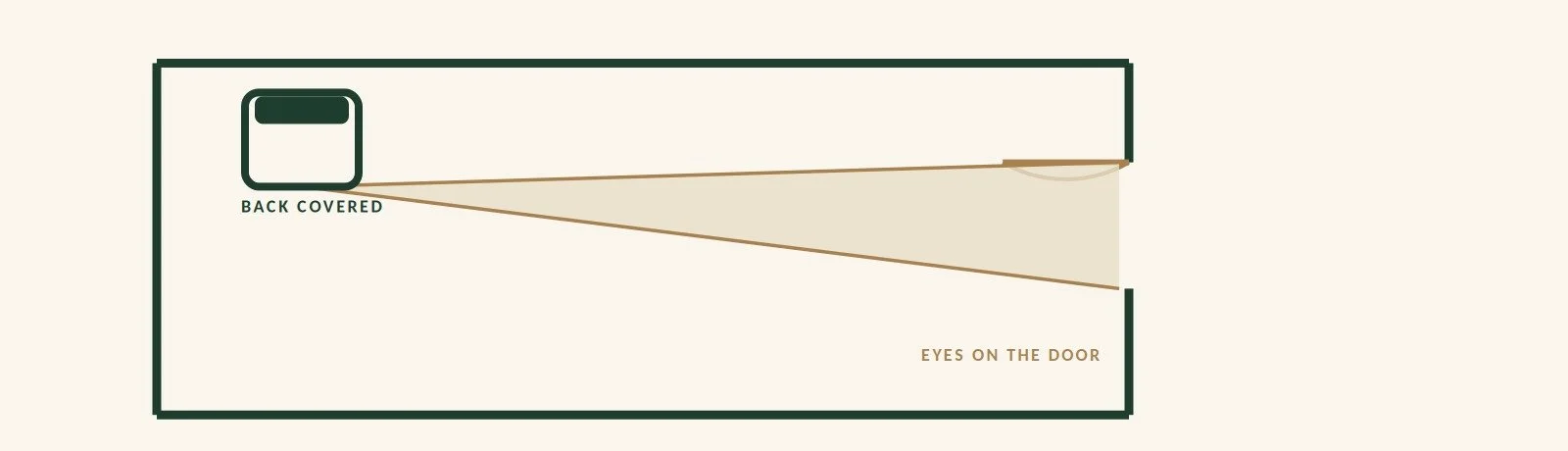
It's the one with something solid behind it and a view of the door.
This is the oldest instinct in the catalog: see without being seen. It's why the corner booth is always taken, why nobody chooses the table in the middle of the floor, and why restaurants can charge you more for a banquette than for the identical chicken twelve feet away.
You floated your sofa in the middle of the living room because a magazine said so. Now the back of your head faces the hallway, and some part of you spends the whole evening at a low simmer, and you think you just don't like that couch.
Fix it:
Every primary seat gets a back. A wall, a bookcase, a console, a tall plant. Something.
Give the main seat a sightline to the room's entry. You want to see who's coming before they arrive.
Leave one clear path out. Not for emergencies. For your amygdala, which is very literal and does not read floor plans.
04 | Air: You are not bad at mornings, you are mildly asphyxiated
Close two adults in a bedroom overnight with the door shut, no ventilation, good windows, tight construction. By 5am the carbon dioxide in that room is high enough that researchers can measure it in your decision-making the next day. Not your mood. Your actual cognitive scores.
You've been telling people you're "not a morning person" like it's a personality. It might be a mechanical ventilation problem.
Fix it:
Crack a window in the bedroom, even an inch, even in winter.
Run the bath fan twenty minutes before bed. It's an exhaust fan. Let it exhaust.
A CO2 monitor is about sixty dollars and will humble you within one night.

05 | The First Eight Feet
Your nervous system does not have a switch. It has a dimmer, and it moves slowly. Which means the transition from out there to in here has to happen somewhere physical, and right now it's happening in a pile of shoes.
Look at your entry. Be honest. It is currently a Bermuda Triangle where one shoe, every receipt you've generated since March, and a single mysterious key all live together in a bowl nobody has emptied since a previous administration.
That's not a clutter problem. That's a landing problem. You never got to land, so you're still carrying the day into the kitchen with you.
Fix it:
One surface to set things down. One hook per human. One place for shoes that is not the floor of the hallway.
Warm light at the door. Low, lamp-level, not an overhead interrogation.
Something soft underfoot in the first three steps. Your body registers the change in surface before your brain registers the change in address.
People report feeling better in an imperfect room they can adjust than in a perfect room they cannot. Agency is the thing. Not the setting.

So what is this actually about
None of this is decoration. It's dosage.
Light, sound, air, sightline, threshold. Five inputs, running on you continuously, whether or not you ever pick a paint color. Your house is going to operate your nervous system for the next twenty years either way.
You can just pick the settings.
There's an order to this, by the way - which room you fix first, and why, and what has to be true before any of it holds. That part doesn't fit in a blog post. But you can start tonight with a dimmer and a lamp below your eye line, and I promise you'll feel it by Thursday.
Live well, build beautifully.
The Arc Collective
An Atlanta-based integrated design, owner's representation, stewardship, and realty firm. We design homes that are good to the people living in them.
