
Beautiful now… Hostile Later…
Five finishes that turn on you, and what to specify instead.
By Ayanna Harrison · Principal Designer & Owner's Representative · 7 min read
I have walked through a lot of gorgeous houses that were quietly plotting against their owners.
Not in a dramatic way. Nothing falls off the wall. It's slower than that. It's a floor that gets slicker with every mopping. It's a countertop you can't see the edge of anymore. It's a beautiful, hard, shiny, high-contrast, low-traction, off-gassing house that photographed like a dream in year one and by year fifteen has become an obstacle course for the exact person who paid for it.
Every finish you select is a bet on who you'll be in twenty years.
Most people are betting they'll be twenty-eight forever, with perfect knees and the retinas of a hawk. It's a bold position. The house is not going to argue with you. It's just going to get quieter and shinier and harder until one day it wins.
Here's how to select finishes that are still on your side later.
01 | Glare: Glare is the villain and polished stone is its agent
Two things happen to your eyes as you age, and they fight each other.
You need more light. Meaningfully more - a sixty-year-old retina receives a fraction of the light a twenty-year-old's does. But at the same time, the lens in your eye scatters light more than it used to. So the same eye that needs more light is also more punished by glare.
Which means the finish that makes a showroom look expensive is the same finish that will make your own bathroom hard to use.
Polished marble. High-gloss lacquer. Mirror-polish porcelain. Chrome under a downlight. All of it takes your beautiful new lighting design and throws it directly into your face as a white hot spot.
Polished stone in a bathroom is a lovely way to meet your local orthopedic surgeon.
Fix it:
Honed, leathered, brushed, matte. You lose nothing. Honed marble in soft light is more expensive-looking than polished marble, and you can actually see the veining instead of a reflection of your ceiling.
Satin or eggshell on walls, not semi-gloss, unless there's a functional reason.
Never aim a downlight at a reflective plane. Light the wall, let the wall light the room.

02 | Contrast: If it all matches, nobody can see it
Here is the single most common expensive mistake I see.
White quartz counter. White porcelain floor. White cabinet. White wall. Congratulations, you have built a snowstorm.
Your eye finds edges by luminance contrast, not by color. That's why a stair with no nosing contrast is dangerous even in bright light, and why a white toilet against a white floor becomes genuinely difficult to locate at night for someone who is seventy and half awake.
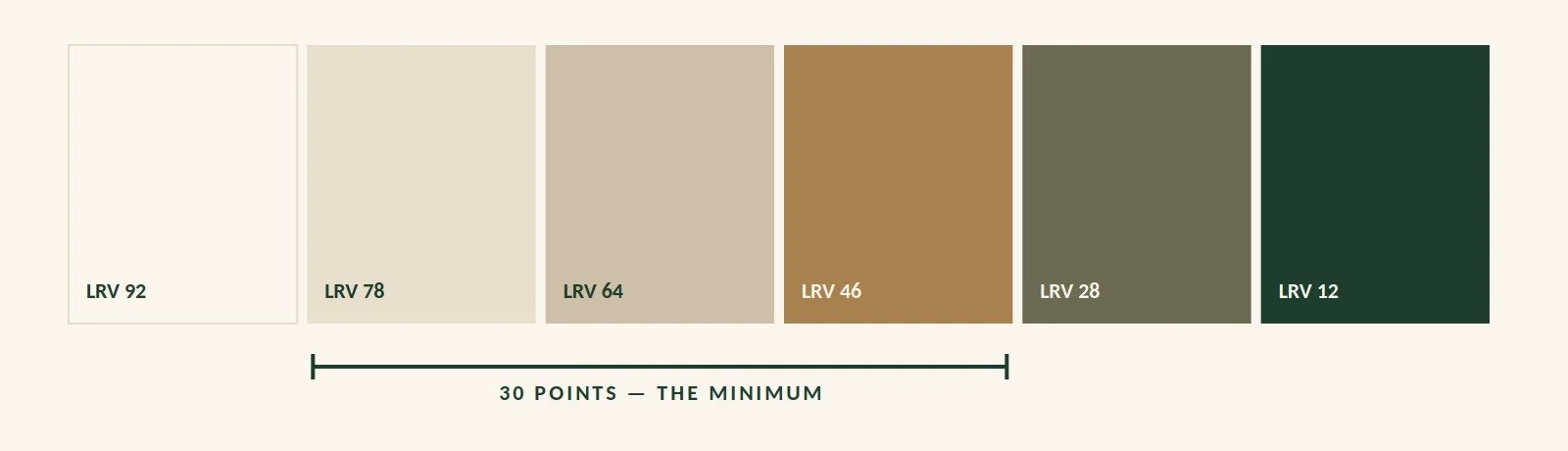
The accessibility world has a rule of thumb worth stealing: aim for at least a 30-point difference in Light Reflectance Value between surfaces that meet. LRV is on every paint chip and most tile spec sheets. It takes four seconds to check and it will still be doing its job in 2050.
Fix it:
Contrast at every plane change. Floor to wall. Wall to trim. Counter to cabinet. Tread to nosing.
The tonal, monochrome, palette is beautiful. Get your contrast from value, not color. Cream walls, oiled walnut counter, matte limestone floor - still quiet, still gorgeous, and readable to an eye that's lost a stop.
The one place to be loud: stair nosings and the toilet. I don't make the rules.
03 | Traction: Traction is a number, not a vibe
Slip resistance is measurable. It's called DCOF, and the standard for interior floors that will get wet is 0.42 or better. It's on the spec sheet. Your tile rep knows it. If they don't, that tells you something.
That stunning large-format polished porcelain in the shower is a 0.20 with soap on it. The showroom will not volunteer this.
Fix it:
Shower floors: smaller tile. More grout joints means more grip, and mosaic conforms to the slope better anyway. Two-inch hex has been solving this problem for a hundred years.
Ask for the DCOF on every wet-area floor before you fall in love. 0.42 wet, minimum.
The area rug in the hallway with no pad is the most dangerous object in your house and you bought it on purpose.

04 | Off-Gassing: That new house smell is a plume
I need you to hear this without panic, because the fix is boring and cheap.
New construction and new furniture off-gas. Composite wood products release formaldehyde. Foam cushions and mattresses carry flame retardants. Finishes, adhesives, and paints release VOCs, heaviest in the first months and tapering for years. Your body is breathing all of it in a building we've spent forty years making more airtight.
That smell you associate with a fresh renovation is a chemical event you find nostalgic.
Fix it:
Specify Greenguard Gold where you can. It's a certification for low chemical emissions and it's now easy to find on cabinetry, furniture, mattresses, paint, and flooring.
Composite wood should be CARB2/TSCA Title VI compliant.Ask. It's a normal question.
Solid wood, wool, natural latex, linen, stone, lime plaster. Old materials don't off-gas because they were never gassed.
Ventilate hard for the first ninety days after any renovation. Windows open, fans running. Free.
Ask one question about every material: when this gets damaged, can it be repaired in place? If the answer is no, you didn't buy it. You're renting it.

Some materials age. Others just fail.
This is the distinction that separates a house that gets better from a house that gets embarrassing.
Materials that age: unlacquered brass, soapstone, oiled white oak, solid brass hardware, wool, vegetable-tanned leather, lime plaster, terracotta, honed limestone, copper. These develop a surface. Ten years in they look like they've been somewhere. Damage becomes character. You can sand, oil, wax, or ignore it.
Materials that fail: lacquered anything, laminate with an applied edge, high-gloss thermofoil, engineered quartz next to heat, most matte black plumbing finishes, luxury vinyl plank. These don't develop a surface. They lose one. The failure is a chip, a delamination, a scorch mark, a worn spot down to the substrate. And there's no repair - only replacement.
A few specifics, since I'm here: engineered quartz is resin, and resin has strong opinions about a hot pot — beautiful counter, and you cannot set a pan on it. Matte black is a finish, a phase, and eventually a lesson; on a faucet that gets daily hand contact, ask about the finish process before you commit. And unlacquered brass will look wrong for about eight months and then look right for the rest of your life. Hold your nerve.
05 | The Quiet Move: Put the wood in now
This is my favorite thing in the world and it costs almost nothing.
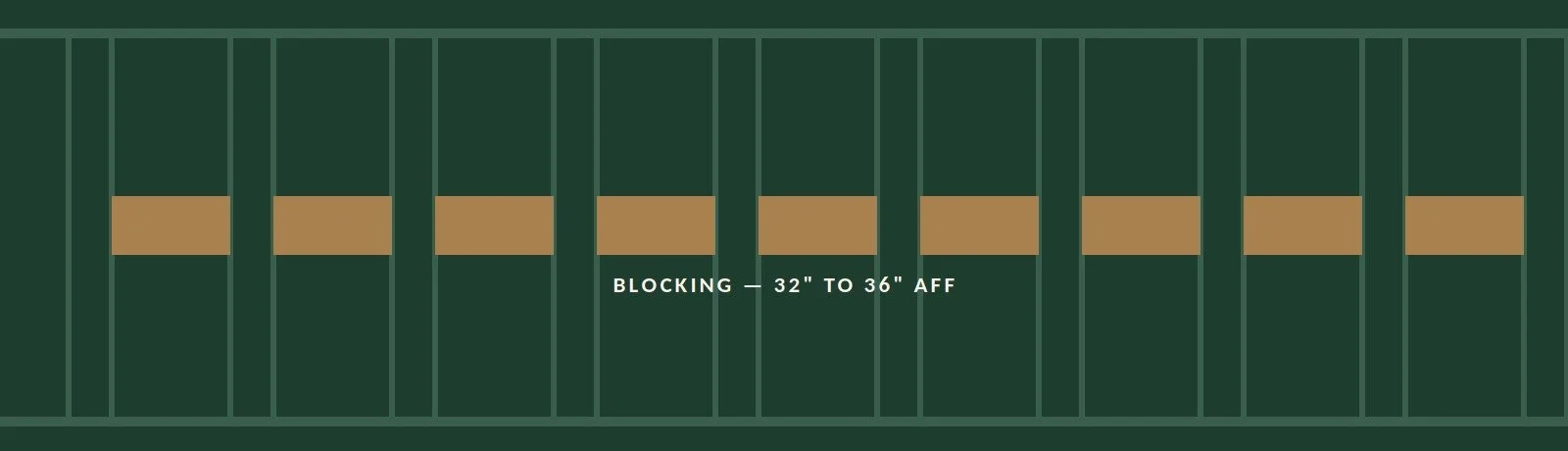
Blocking. Two-by lumber in the wall behind the drywall, at the heights where a grab bar would go, in every bathroom, at the shower, at the tub, beside the toilet. It's a couple hundred dollars during framing. Nobody will ever know it's there.
And then one day, someone has a hip replacement, or is pregnant and dizzy, or is eighty-four and still living in their own home, and a bar goes up in twenty minutes into solid wood instead of a two-week project involving demo and tile that no longer matches.
The bar goes in later. The wood goes in now.
While the walls are open, also free:
36-inch doors at the main path. Reads as generous, delivers 32 inches of clear width, which is the number that matters when anything with wheels comes through.
Zero-threshold shower. Now the best-looking option in the catalog and the one you can roll into.
A full bath and a room that could be a bedroom on the main level. Even if it's an office today.
Blocking at the stairs for a rail on both sides, whether or not you install the second one yet.
None of this looks like accessibility. All of it is. That's the whole point. Longevity design done well is invisible until the day it's the reason you're still home.
The actual thesis
Longevity is not a ramp you install at seventy. It's a series of small, unglamorous, structural decisions you make at forty while you're picking tile, most of which cost nothing extra and none of which have to be ugly.
Reduce glare. Build in contrast. Check the traction number. Ask what it off-gasses. Choose materials that can be repaired. Put the wood in the wall.
Do that, and the house you love at forty-five is still on your side at seventy-five, and nobody ever has to have The Conversation about whether you can stay in it.
Which decisions matter most in your house, and in what order, depends on things a blog post can't see. That part's ours. But every item on this list is one you can hand your builder on Monday.
Live well, build beautifully.
The Arc Collective
An Atlanta-based integrated design, owner's representation, stewardship, and realty firm. We design homes that are good to the people living in them — including the ones they'll be in thirty years.
